
A blog post by Bigfoot Arts Education | Reading time: 5–6 minutes
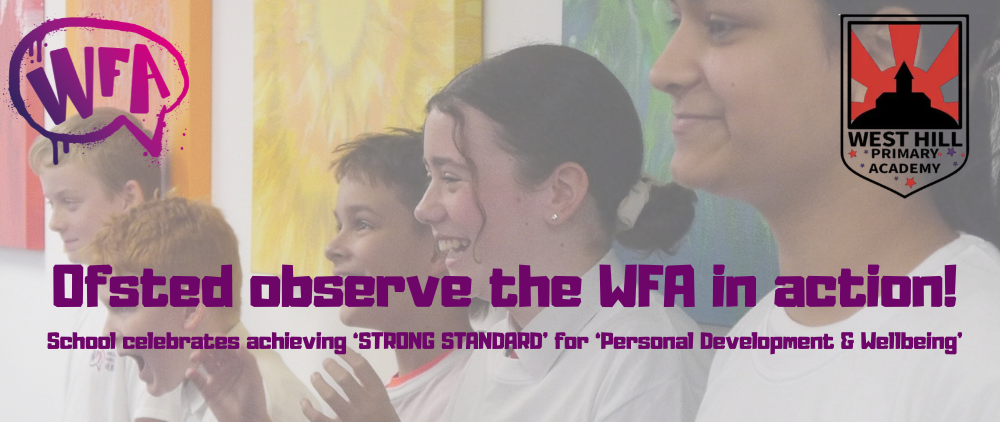
When Ofsted inspectors arrived at West Hill Primary Academy in Dartford in January 2026, they witnessed something that no policy document or self-evaluation form can replicate: children actively leading their peers. A live peer mentoring session from Bigfoot Arts Education’s World Friendship Ambassador (WFA) programme was in full flow and what inspectors saw clearly helped leave a positive mark.
The school was awarded a Strong Standard in Personal Development and Wellbeing, the second-highest grade available under Ofsted’s new Report Card framework. They were also awarded ‘Expected Standard’ for all other areas and ‘Safeguarding Standards Met’, resulting in West Hill receiving a highly positive and celebratory report, a true reflection of an exceptional Leadership Team, as well as pupils who thrive in a school they enjoy and respect.
So what did inspector see when they visited and how does this relate to your school?
What Ofsted Said About West Hill
The inspection report, published 23 March 2026, was unambiguous in its praise for the quality of personal development on a whole at West Hill. The school prides itself on providing a wealth of enrichment opportunities for all children, recognising how important these are for helping children to develop life skills. Inspectors wrote:
“Pupils welcome the opportunity to take on leadership roles in order to give back to their community.“
“Pupils who have responsibility for championing equality actively promote the school’s ethos among their peers.
“Pupils are very well prepared for life in modern Britain. They know how to resolve conflict and listen respectfully to other perspectives.”
— Ofsted Inspection Report, West Hill Primary Academy, January 2026
The report helped highlight how pupils demonstrate a “detailed understanding of how to live a healthy life and how to stay safe” and are “highly respectful of one another’s differences”. These are not abstract qualities, but are the direct outcomes of a school that has invested heavily in well planned and structured personal development opportunities, with the WFA programme being a visible and living part of that story on the day of inspection.
The New Ofsted Framework: What Personal Development Now Means
Under Ofsted’s new inspection framework, Personal Development and Wellbeing is one of nine distinct evaluation areas, each graded separately on a five-point scale: Exceptional, Strong Standard, Expected Standard, Needs Attention, and Urgent Improvement.
This is not a box-ticking exercise. Inspectors are specifically trained to look for evidence that personal development is genuinely woven through school culture, not bolted on as an afterthought. Crucially, oracy has emerged as a key focus: inspectors want to see pupils who can articulate their ideas, engage in structured conversation, and communicate confidently with peers and adults. They are also looking at inclusion as a thread running through every area of school life, and at whether schools can demonstrate a culture of belonging that is felt, not just stated.
Achieving a Strong Standard, as West Hill Primary Academy did, requires leaders and staff to have a deep understanding of all their pupils, to provide broad and coherently planned personal development provision, and to ensure that children leave school confident, resilient, and ready for the next stage of their lives.
That is exactly what the World Friendship Ambassador programme is designed to deliver.
What the WFA Programme Delivers — and Why It Works
Bigfoot’s World Friendship Ambassador programme is a flexible video-based platform designed for KS2 pupils in primary schools. At its heart is the idea that children learn best from each other, and that peer mentoring, when properly structured, is one of the most powerful tools a school can have.
Selected pupils are trained as WFA Mentors by Bigfoot’s Senior Arts Educator, Adrian Benn, who has been at the forefront of creative education for nearly two decades. Through three carefully designed modules- Positive Communication, Healthy Relationships, and Feeling Good– mentors are equipped to lead meaningful, age-appropriate conversations with their peers about the things that really matter.
The programme builds:
• Leadership and responsibility
• Oracy and confident communication
• Empathy, kindness, and emotional intelligence
• A sense of equity, belonging, and inclusion
• Resilience and personal wellbeing
Crucially, the programme requires minimal input from already-stretched teaching staff. It is designed to fit around your school’s schedule by slotting into PSHE lessons, school council sessions, Rights Respecting Schools activities, and/or after-school clubs.
This is not a one-off workshop. It is a sustainable, year-round programme that becomes part of a school’s culture and is passed on from one cohort of mentors to the next, year after year.
What Inspectors See When WFA Is in Action
When Ofsted arrived at West Hill Primary Academy and observed a WFA peer mentoring workshop in progress, they were not watching a rehearsed presentation or a curated display of provision. They were watching school culture in real time as peers led peers in engaging creative workshops. They led activities, facilitated discussions, and assisted children to take part in the session by helping to support, engage and interact with one another.
That is the difference between programmes that exist on paper and programmes that are truly embedded. The WFA workshop that inspectors watched was the natural progression of what West Hill’s peer mentors had been learning and practising. They saw a group of 10 x Year 6 pupils working with their Year 5 and 6 peers to deliver a workshop on ‘Feeling Good’, continuing their roles to champion kindness, equity and belonging across the school. Just as they had been trained to do.
As the Ofsted report noted, pupils at West Hill “recognise that their voices matter” and are “confident and articulate when leading assemblies”. These are pupils who have been given both the skills and the platform to lead, and the WFA programme is a contributing element for how teachers encourage that confidence to be cultivated within school.
The Case for Every School to Join
West Hill Primary Academy’s experience is not a one-off. It is a demonstration of what happens when a school invests in structured and purposeful personal development provision, along with what Ofsted will recognise when they see it in action for themselves.
With the new inspection framework firmly in place, schools across England need to be able to demonstrate, not just describe, the quality of their personal development and wellbeing provision. Inspectors want to see provision that is broad, coherently planned, and embedded in everyday school life. They want to see pupils who are confident, empathetic, articulate, and ready for life in modern Britain.
The World Friendship Ambassador Peer Mentoring programme helps to give schools a clear structure for achieving exactly that. It is affordable, it is flexible and it is linked directly to RSE and PSHE curriculum. And, as West Hill’s 2026 Ofsted inspection proved, when inspectors walk in and find it happening, it can help make a real and lasting impression.
“We are all delighted that Ofsted has confirmed what we already knew – that West Hill is a great school.
I am especially pleased that Ofsted has recognised the school’s strong standards on pupils’ personal development and wellbeing.”
— Garry Ratcliffe, Chief Executive, The Golden Thread Alliance
Join the Friendship Revolution
The WFA programme is open to primary schools across the UK and is designed to start a friendship revolution. If your school is working towards a Strong Standard or higher in Personal Development and Wellbeing, this is one of the most impactful steps you can take.
Don’t wait until your next inspection. The children in your school deserve the skills, the confidence, and the sense of belonging that the World Friendship Ambassador programme builds, right now, every day, not just when Ofsted comes to call.
Find out more at bigfootartseducation.co.uk/wfa
or email wfa@bigfootartseducation.co.uk